

Limits of stateless RAG
In traditional RAG, you chunk and embed text for retrieval based on semantic similarity. This works for static information but fails to capture relationship dynamics or state changes.The evolving fact
- Monday: “I am working on Project Apollo.”
- Wednesday: “I am pausing Apollo to focus on Project Hermes.”
- Friday: “What am I working on?”
Stateful memory
Worlds maintains a living knowledge graph. Instead of storing raw text, it extracts meaning as triples (subject → predicate → object). When facts change, Worlds updates the specific relationships in the graph. This allows you to resolve contradictions at the data layer rather than relying on probabilistic LLM reasoning.RAG vs Worlds
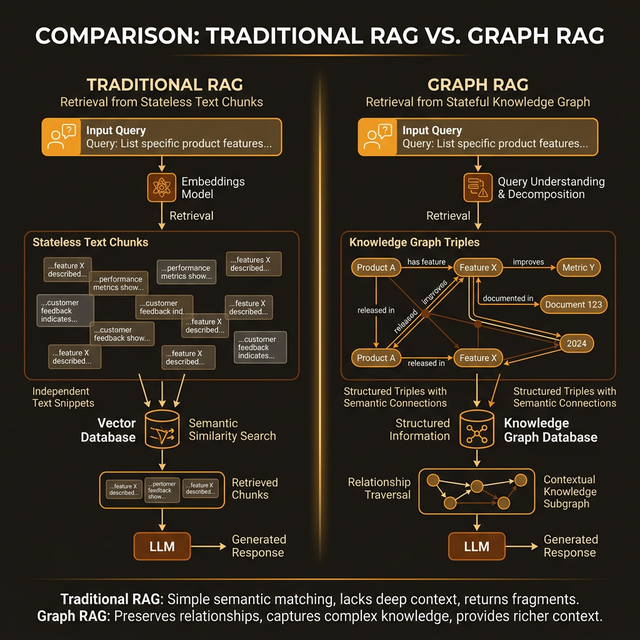
| Feature | Traditional RAG | Worlds, functioning as world memory |
|---|---|---|
| Search | Semantic similarity | Hybrid, combining semantic and relational |
| State | Stateless | Stateful, resolving contradictions |
| Inference | Hallucination-prone | Deterministic reasoning |
| Structure | Unstructured chunks | Knowledge primitives, namely items and triples |