

| Component | Role | Example |
|---|---|---|
| Subject | The item being described | user:ethan |
| Predicate | The relationship or property | schema:worksAt |
| Object | The target value or item | org:wazoo |
Anatomy of a triple
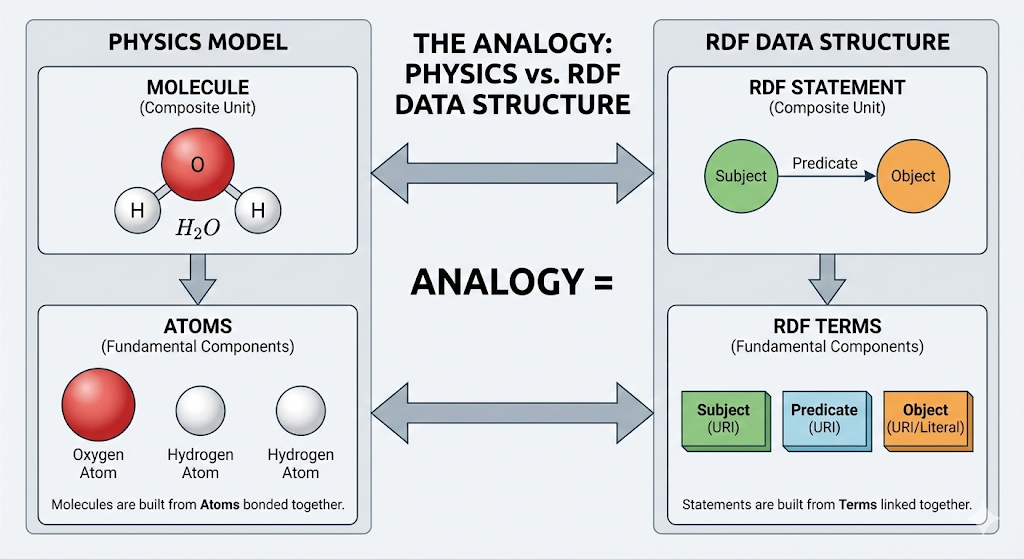
- Named nodes (URIs/IRIs): Unique identifiers that point to specific, global items or properties. Subjects and Predicates must always be named nodes, allowing them to explicitly link to other parts of the graph.
- Literal nodes (Values): Raw data values, such as strings, numbers, or
dates (e.g.,
"Ethan",42). Literals can only ever be Objects. They sit at the edge of the graph and cannot have outbound relationships.
Why triples?
Triples follow the RDF (Resource Description Framework) standard. Because every fact shares the same structure, triples compose naturally into a graph—no schema migrations, no table joins. As the graph grows, the agent can traverse relationships to infer new knowledge (for example, that Ethan and Gregory share the same work location).Learn more
- Academy: Symbolic graph architecture — building graphs from triples
- Knowledge Graphs guide — advanced graph topologies