

Knowledge primitives
To build with Worlds, you must understand the three fundamental building blocks of knowledge.Items
Items are the distinct “things” in your world—a person, a piece of code, or a company.- Identification: A unique IRI, or Internationalized Resource Identifier, identifies every item.
- Classes: Categorize items by their type, such as
User,Project, orTask.
Properties
Properties are the “verbs” or “connectors” that define how items relate.- Examples:
worksOn,managerOf,hasPriority. - Ontology: The set of defined properties forms the “grammar” of your world, ensuring your agents use consistent language.
Facts
A fact occurs when you connect two items using a property. This follows the standard W3C RDF triple structure:| Component | Example |
|---|---|
| Subject | User:Ethan |
| Predicate | isWorkingOn |
| Object | Project:Worlds-API |
Why graphs matter
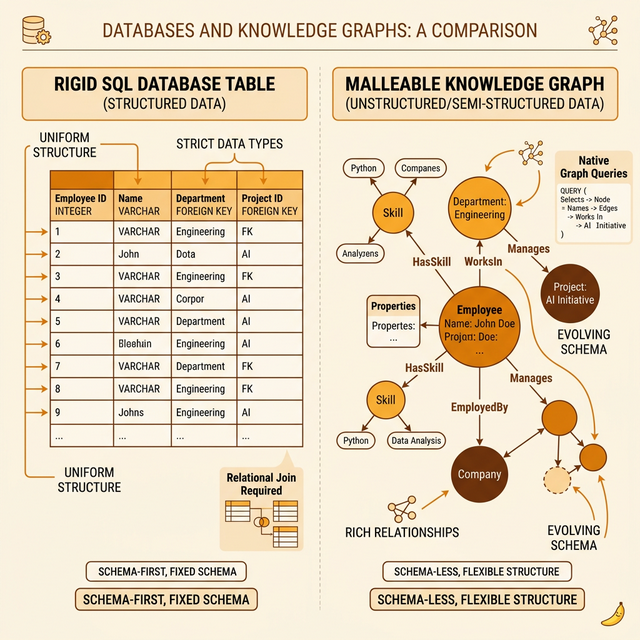
Meaning at scale
Historically, there has been a trade-off between semantic interoperability and analytical performance.- Semantic precision: RDF (Resource Description Framework) uses standard URI-based triples to define canonical vocabularies and ensure global interoperability. It is the gold standard for representing knowledge, but traditional RDF databases can be slow for traversing dense connection paths.
- Analytical scale: Continuous AI workflows (like GraphRAG) require high-velocity, graph-native operational infrastructure to traverse complex relationships quickly under pressure.
- Malleability: Mutate and fork graphs in real-time.
- Traceability: Every claim provides a symbolic path back to its source.
- Evolution: New facts can surgically update or override old ones to maintain grounded truth.