

Items
Worlds represents everything as an item, including the types themselves. This recursive structure enables granular, multi-hop reasoning. An item is…- Assigned a unique IRI.
- Defined by one or more facts.
- Any “thing” in your world, including documents, people, physical objects, and abstract concepts.
Properties
Properties connect items. They define actions or attributes, such asworksFor
or givenName. The set of valid properties forms the graph’s vocabulary. Agents
use these properties to navigate and mutate state precisely.
Facts
A fact is a unit of data expressed as a structured statement that connects two items using a property. Every fact is tied to a moment in time. Worlds keeps an append-only, chronological ledger of facts, so agents can trace exactly how state and information change. Conceptually, a fact is a structured assertion. For example, you can represent the assertion “Ethan is a person” as:Triples
Computers store facts in a data structure called the triple, which is built from three components called terms.Anatomy
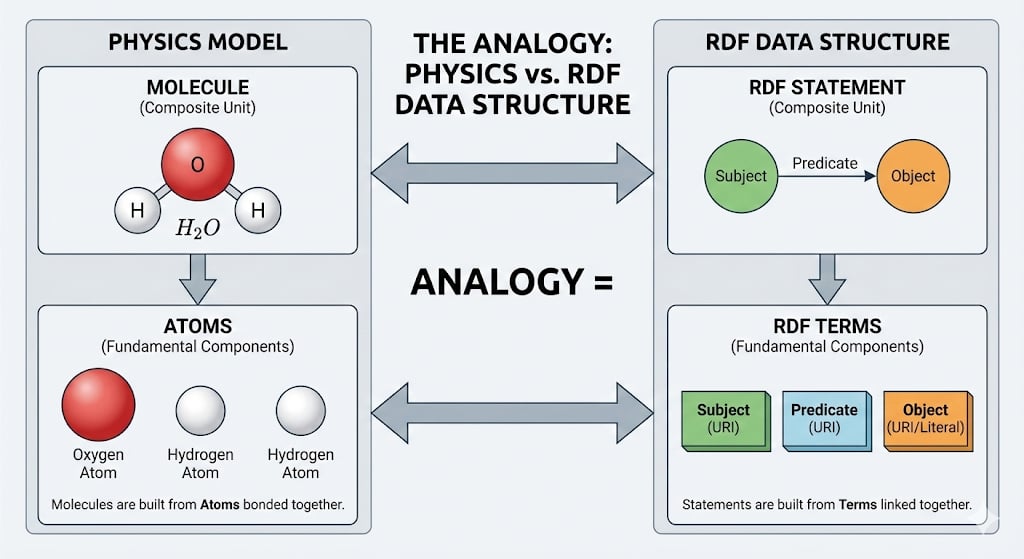
Analogy between triples and molecules
Term
The item you are describing e.g.,
user:personTerm
The structural representation of a property e.g.,
rdf:typeTerm
Another item or a raw data value e.g.,
schema:PersonTopography
The Object of a triple determines how the graph grows. Facts branch into two types:- Item-to-item: Connects two distinct items e.g.,
user:person->schema:knowsAbout->wazoo:worlds - Item-to-value: Connects an item to a raw data value that is searchable but
terminates the branch e.g.,
user:person->schema:givenName->"Ethan"
Serialization
Worlds uses standard RDF serialization formats to express triples in plain text. For how to load serialized data into a world, see Update. To assert “Ethan is a Person”, use:Verification
To verify a fact, Worlds runs a graph pattern query (SPARQL ASK). This returns a deterministic boolean answer and does not rely on probabilistic guessing. See Query for how graph pattern queries work with Worlds. For example, to verify if “Ethan knows about Worlds”, use:SPARQL
wzw_ world token:
boolean: true when the fact is verified.
Why care?
Worlds is built on standard knowledge representation formats. This gives autonomous agents an interoperable foundation for reasoning.Next steps
- Search: hybrid retrieval over a world