> ## Documentation Index
> Fetch the complete documentation index at: https://docs.wazoo.dev/llms.txt
> Use this file to discover all available pages before exploring further.
# Worlds
> The neuro-symbolic components of verifiable context.
A [world](/glossary#world) is a stateful, synchronizable dataset that acts as an
agent's verifiable context. Worlds' default engine models worlds as knowledge
graphs, but the world contract is data-model agnostic: a world can also be
backed by a relational database or another syncable store.
Worlds works best when memory is curated, not accumulated. Store durable facts
in a world and discard the rest.
```mermaid theme={null}
graph LR
Agent([AI agent]) -->|query / update| W[(World)]
subgraph W [World]
direction TB
RDF[RDF graph]
SEARCH[Search index]
end
```
A world is made of items made of facts.
## Items
Worlds represents everything as an item, including the types themselves. This
recursive structure enables granular, multi-hop reasoning.
An item is...
* Assigned a unique
[IRI](https://en.wikipedia.org/wiki/Internationalized_Resource_Identifier).
* Defined by one or more facts.
* Any "thing" in your world, including documents, people, physical objects, and
abstract concepts.
## Properties
Properties connect items. They define actions or attributes, such as `worksFor`
or `givenName`. The set of valid properties forms the graph's vocabulary. Agents
use these properties to navigate and mutate state precisely.
## Facts
A fact is a unit of data expressed as a structured statement that connects two
items using a property. Every fact is tied to a moment in time. Worlds keeps an
append-only, chronological ledger of facts, so agents can trace exactly how
state and information change.
Conceptually, a fact is a structured assertion. For example, you can represent
the assertion "Ethan is a person" as:
```mermaid theme={null}
graph LR
A((Ethan)) -->|is a| B((Person))
style A fill:#FF9800,stroke:#F57C00,color:#fff
style B fill:#FF9800,stroke:#F57C00,color:#fff
```
## Triples
Computers store facts in a data structure called the triple, which is built from
three components called terms.
### Anatomy
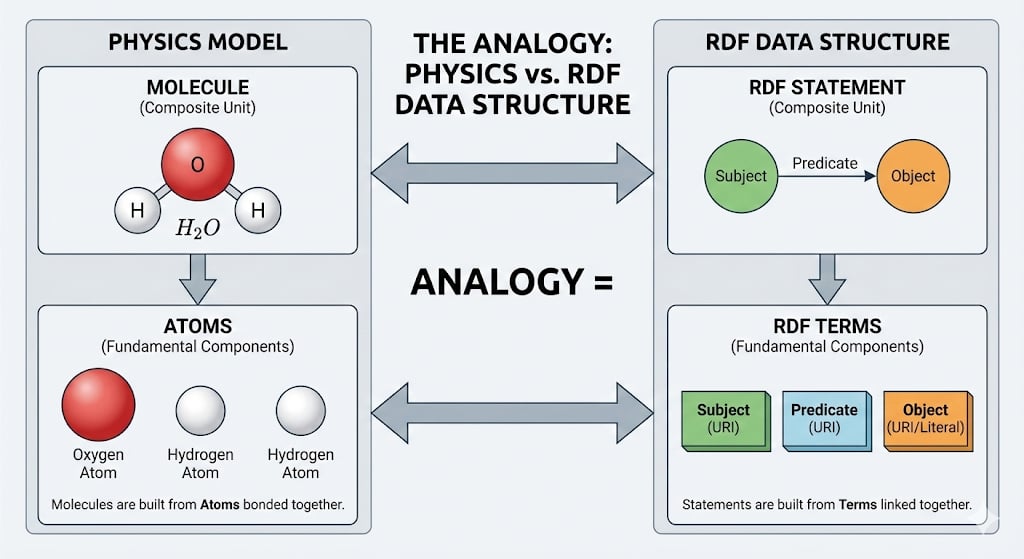 The item you are describing e.g., `user:person`
The structural representation of a property e.g., `rdf:type`
Another item or a raw data value e.g., `schema:Person`
### Topography
The Object of a triple determines how the graph grows. Facts branch into two
types:
* Item-to-item: Connects two distinct items e.g., `user:person` ->
`schema:knowsAbout` -> `wazoo:worlds`
* Item-to-value: Connects an item to a raw data value that is searchable but
terminates the branch e.g., `user:person` -> `schema:givenName` -> `"Ethan"`
The item you are describing e.g., `user:person`
The structural representation of a property e.g., `rdf:type`
Another item or a raw data value e.g., `schema:Person`
### Topography
The Object of a triple determines how the graph grows. Facts branch into two
types:
* Item-to-item: Connects two distinct items e.g., `user:person` ->
`schema:knowsAbout` -> `wazoo:worlds`
* Item-to-value: Connects an item to a raw data value that is searchable but
terminates the branch e.g., `user:person` -> `schema:givenName` -> `"Ethan"`
```mermaid theme={null}
graph LR
subgraph "Memory graph"
A((user:person)) -->|schema:knowsAbout| B((wazoo:worlds))
A -->|schema:givenName| C[/"Ethan"/]
end
style A fill:#FF9800,stroke:#F57C00,color:#fff
style B fill:#FF9800,stroke:#F57C00,color:#fff
style C fill:#FFB74D,stroke:#FF9800,color:#000
```
### Serialization
Worlds uses standard RDF serialization formats to express triples in plain text.
For how to load serialized data into a world, see [Update](/worlds/update).
To assert "Ethan is a Person", use:
```turtle Turtle theme={null}
@prefix user: .
@prefix schema: .
user:person a schema:Person .
```
```json JSON-LD theme={null}
{
"@context": {
"user": "https://etok.me/#",
"schema": "https://schema.org/"
},
"@id": "user:person",
"@type": "schema:Person"
}
```
```turtle N-Triples theme={null}
.
```
```html Microdata theme={null}
```
Items can consolidate multiple facts into a single structure. This example
asserts that Ethan is a person with the given name "Ethan":
```turtle Turtle theme={null}
@prefix user: .
@prefix schema: .
user:person a schema:Person ;
schema:givenName "Ethan" .
```
```json JSON-LD theme={null}
{
"@context": {
"user": "https://etok.me/#",
"schema": "https://schema.org/"
},
"@id": "user:person",
"@type": "schema:Person",
"schema:givenName": "Ethan"
}
```
```turtle N-Triples theme={null}
.
"Ethan" .
```
```html Microdata theme={null}
Ethan
```
## Verification
To verify a fact, Worlds runs a graph pattern query (SPARQL ASK). This returns a
deterministic boolean answer and does not rely on probabilistic guessing. See
[Query](/worlds/query) for how graph pattern queries work with Worlds.
For example, to verify if "Ethan knows about Worlds", use:
```sparql SPARQL theme={null}
PREFIX wazoo:
ASK WHERE {
wazoo:knowsAbout .
}
```
In the API, use the data-plane SPARQL endpoint with a `wzw_` world token:
```bash theme={null}
curl -s -X POST "https://worlds-api.wazoo.dev/worlds/my-world/sparql" \
-H "Authorization: Bearer $WORLDS_TOKEN" \
-H "Content-Type: application/json" \
-d '{
"query": "PREFIX wazoo: ASK WHERE { wazoo:knowsAbout wazoo:worlds . }"
}'
```
The response returns `boolean: true` when the fact is verified.
## Why care?
Worlds is built on standard knowledge representation formats. This gives
autonomous agents an interoperable foundation for reasoning.
## Next steps
* [Search](/worlds/search): hybrid retrieval over a world